guides
Best Training Aids for Breaking Putts (Stop Aiming at the Cup)
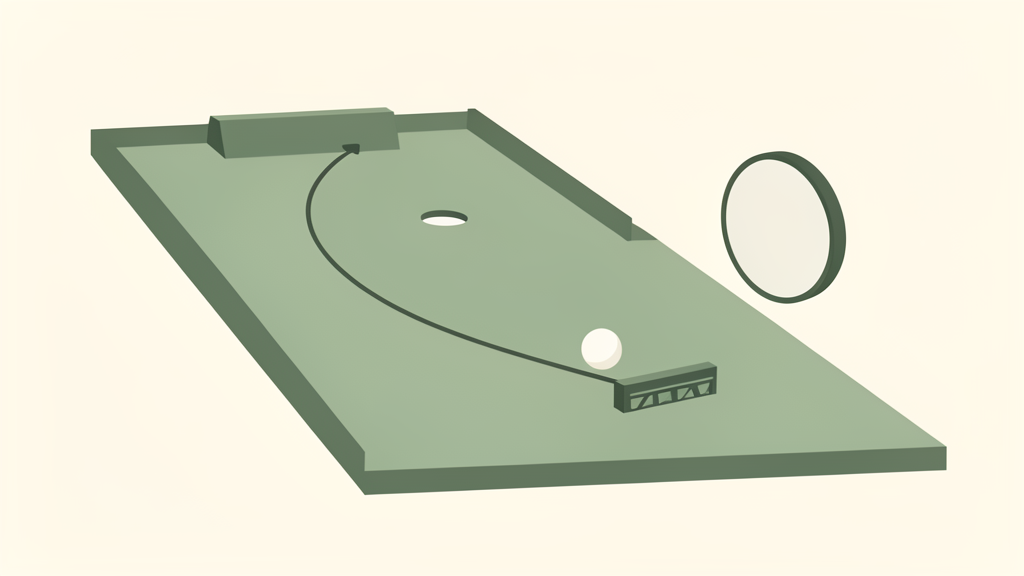
Every putting mat I have ever owned is dead flat. So is yours, probably. You roll a hundred putts a week on a flat mat, groove a beautiful straight stroke, and then show up to a real green where almost nothing is flat. You read a putt with three feet of left-to-right break, aim at the cup out of habit, and watch the ball slide six inches wide.
The flat mat did not just fail to help. It actively trained the wrong instinct. Every drill on a flat surface teaches you to aim at the center of the hole and trust your stroke. A breaking putt requires the opposite move: aim outside the cup, at a spot with no hole in it, and trust a line that looks wrong. That is a completely different skill from stroke mechanics, and almost nobody practices it on purpose.
I already covered stroke-path and pace fixes in Best Putting Aids 2026 and reviewed the AirBreak’s fit for single-digit players in 2 PuttOut Aids That Challenge a 5-Handicap. This guide is narrower on purpose. These three tools train the specific job of reading a slope and committing to a line that is not straight at the hole.
EyeLine Putting Alignment Mirror: $36-$40
Best for: Confirming your eyes are actually looking where you think they are before you try to read any break at all.
This is a flat acrylic mirror with printed lines for eye position, shoulder alignment, and putter face. You set it down, stand over it, and look at your reflection. Most golfers discover their eyes sit two inches inside the target line without realizing it. On a straight putt that costs you a few makes. On a breaking putt it wrecks your read entirely, because you cannot judge a curving line accurately if your eyes are not stacked correctly over the ball in the first place. EyeLine has more than 2,600 Amazon reviews at 4.5 stars, and Rory McIlroy uses one in the company’s own instructional material.
What does not work. It is a diagnostic tool, not a break-reading tool. It will not teach you how much a putt breaks. It just makes sure your eyes are not lying to you before you start.
Verdict: Buy it. At $36, it is the cheapest fix on this list and the one every golfer should own before anything else here. Fix your eyes first. Everything downstream gets easier.
Visio Adjustable Putting Gate: $47
Best for: Golfers whose stroke wanders off the intended line the moment they try to start a putt outside the cup.
Aiming at a spot with no hole in it feels unnatural. Most golfers who try to play a breaking putt end up steering the putter back toward the center of the cup mid-stroke, which is the opposite of what the read called for. The Visio gate is two adjustable posts you set on the ground with just enough gap for your putter to pass through cleanly. Set the gate on your intended starting line, not on the cup, and you get instant feedback the moment your stroke drifts back toward the hole. Phil Kenyon, one of the most respected putting coaches working with tour players, uses this exact drill with his students.
What does not work. The gate does not create actual break. It only trains the mechanical discipline of starting the ball on a line you have chosen, even when that line looks wrong. You still need a way to practice real slope.
Verdict: Worth it if you have already caught yourself steering back toward the cup on breaking putts. At $47, it fixes the specific habit that undoes a good read.
PuttOut AirBreak: $340-$400
Best for: Mid-to-low handicappers who read greens fine on the course but never get to practice trusting that read at home.
This is the only product on this list that creates actual, adjustable break. It is an 8-foot mat on a folding platform with 8 independent air pumps underneath. Press a pump with your foot and that section of the mat rises, creating slope. You can dial up to 7.5% side break and 3% of up or downhill grade in about 30 seconds, in any combination. A built-in ball return sends makes back to your feet so you can run 50 putts in 10 minutes without bending over once.
The whole point is the trust gap. A flat mat never asks you to aim outside the hole. The AirBreak forces it every single time, and it gives you the one thing a real green cannot: instant repeatable feedback on whether your read and your line matched. Golf Monthly called it “a real breakthrough in the home putting space,” and I found the same thing testing it for two weeks. Straight putting practice had made me a confident 8-footer putter and a nervous break-reader. The AirBreak is the only product that trains the second half of that equation.
What does not work. The price is real money, on par with six dozen Pro V1s. The stance podium sits you slightly farther from the ball than a normal setup, and the 8-foot length caps you out on lag putts past that distance.
Verdict: Worth it if you already have a repeatable stroke and your misses on the course are read errors, not mechanical ones. Skip it if you are still working on basic pace control; the Pressure Putt Trainer at $30 solves that problem first for a fraction of the cost.
What I Would Actually Buy
If you only buy one thing, get the EyeLine Mirror for $36. Bad eye position undermines every other read you will ever make, and fixing it costs less than a sleeve of premium balls.
If you have $83 to spend, add the Visio Gate to the mirror. Now you are checking your eyes and training your stroke to hold a line that is not the cup, which is 90% of what breaking putts actually require.
If breaking putts are costing you strokes on the course every single round and you have the floor space, the AirBreak at $340-$400 is the only tool that lets you rehearse the actual skill: read it, aim outside the hole, trust it, watch it turn. That is not a stroke-mechanics problem. It is a nerve problem, and the AirBreak is the only home product that trains your nerve on a curving line.
Where to Buy
- EyeLine Putting Alignment Mirror $36-$40 at Amazon
- Visio Adjustable Putting Gate $47 at Amazon
- PuttOut AirBreak $340-$400 at Amazon (also Dick’s and Golf Galaxy)
As an Amazon Associate we earn from qualifying purchases.