guides
Fix Pulling Shots Left: 5 Aids I Tested, $15-$295
I fixed my slice and immediately started pulling everything left. Not a hook. A straight pull. The ball starts left of my target and stays there, dead straight, no curve, no coming back. My playing partners stopped saying “nice swing” and started asking where I was aiming. I was aiming at the flag. The ball just refused to go there.
The pull is the miss nobody writes about. This site has eight articles on hooks and slices and every curved miss in between, and not one of them covers the pull. It is not dramatic. It is not a 40-yard banana into the trees. It is a quiet, straight miss that costs you three strokes a round, and nobody can explain why it happens.
Buy alignment sticks first. For $15 they rule out the most common pull. After that, the right tool depends on which pull you actually have.
If your ball starts left and stays left, you do not have a hook problem. You have a path problem, a face problem, or an alignment problem. Each one needs a different fix.
Which Pull Is Yours?
There are three ways to pull a ball straight left. Three minutes on the range tells you which one you have.
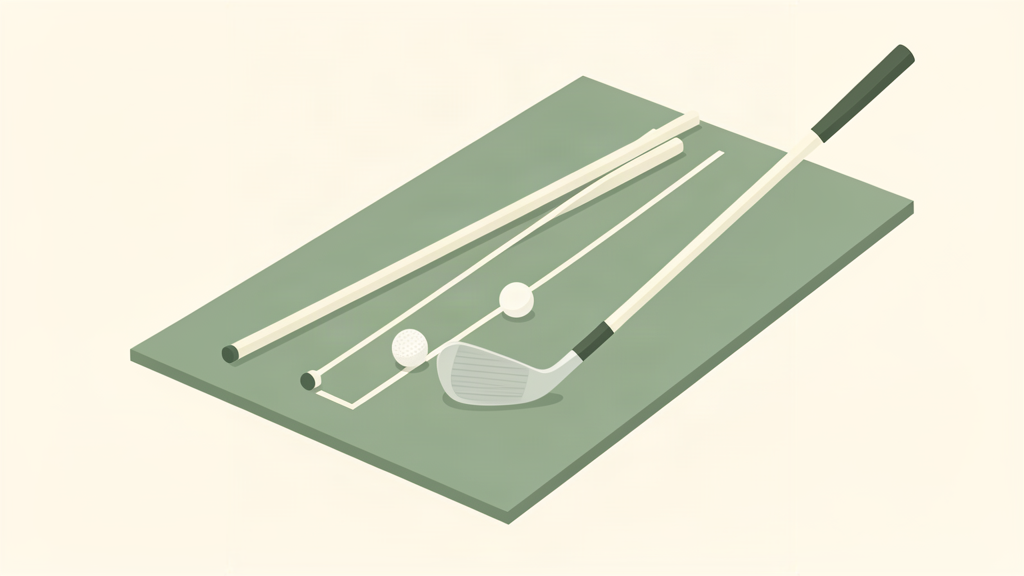
Test 1: The alignment check. Set up to a target like you are about to hit a 7-iron. Without moving your feet, lay a club across your toes and step back. If it points left of your target, you have an alignment pull. Your swing is fine. You are aimed left. This is the most common pull, and the one golfers skip because it feels too obvious.
Test 2: The divot check. Hit five balls and look at where the divots point. If they point left of your target, your path is cutting across the ball from outside to inside. That is the over-the-top pull. Your face is square and your path cuts left, so the ball starts left and stays left.
Test 3: The face check. If your divots point straight at the target but the ball still goes left, your path is fine and your face is shut. You are flipping your wrists through impact. That is the closed-face pull.
If your ball starts left and then curves further left, that is a pull-hook, not a straight pull. Read the hook fix guide and the hook aid roundup instead.
If you pass all three tests and the ball still flies straight left, book a lesson. For everyone else, the fix matches the test you failed.
Alignment Sticks: The $15 Fix Most Golfers Skip
If you failed Test 1, you do not need a $300 sensor. You need two fiberglass sticks that cost about $15 to $30.
Lay one stick on your target line and one parallel to it across your toes. Set up so your feet, hips, and shoulders all match the toe line. It sounds stupidly simple, and that is exactly why people skip it. Most of the mid-handicappers I play with have been aimed 5 to 10 yards left for years and have spent hundreds of dollars trying to fix a swing that was never broken.
What does not work: alignment sticks do not fix a swing fault. If you failed Test 1, they fix your pull in one range session. If you failed Test 2 or 3, they just make you better aimed while you still pull it. Know which one you have before you buy.
The five drills are in their own guide: alignment stick drills.
Tour Striker Educator: The Wrist Fix for a Closed Face
If you failed Test 3, the problem is your wrists. The Tour Striker Educator straps to your lead wrist with a plastic arm that runs up your forearm. If you cup or flip your wrist through impact, the arm digs into your forearm. You feel the mistake the instant you make it.
That is exactly what a closed-face pull is. The face slams shut because your lead wrist flips through the ball. The Educator makes that flip physically impossible without hurting. A hundred reps later, your wrist learns to stay flat and the face stops rotating shut.
It costs about $50 to $65 on Amazon, less than a box of Pro V1s, and you can drill it in your living room five minutes a day.
What does not work: the Educator only gives you feedback on the wrist. If your path is the problem (Test 2), it will not fix it. And the feedback is blunt. It does not tell you how many degrees your wrist is off. It just tells you that you flipped.
HackMotion Core: The Data Version of the Same Fix
If you want to know exactly what your wrists are doing instead of just feeling it, the HackMotion Core is the sensor version of the Educator. It straps a small sensor to your wrist and measures your angle in real time, in degrees, on your phone.
This is the buy for someone who wants numbers, not feelings. If you work with a coach, or you are the type who needs to see negative 8 degrees of extension to believe it, this is your tool. It costs $295 and it is sold direct at hackmotion.com, not on Amazon.
What does not work: $295 is a lot of money for feedback the Educator gives you for about $50. The HackMotion tells you your wrist is flipping. The Educator stops the flip. For a mid-handicapper fixing a pull solo, the physical feedback wins, and the Educator does the same job for a fifth of the price.
ProSENDR PlaneMate: The Fix for an Over-the-Top Pull
If you failed Test 2, your path is the problem, and the PlaneMate is the tool that fixes it. It is a resistance band that clips to your club and wraps around your waist. When you swing over the top, the band goes slack. When you shallow the club from the inside, the band stays taut and guides your path.
The over-the-top pull is the mirror of the over-the-top slice. Same move, different face. The PlaneMate physically stops the club from cutting across the ball from outside to inside. I used it for a month and my path went from 6 degrees out-to-in to 2 degrees in-to-out. The pull went with it.
One note: Tour Striker sold the PlaneMate line to ProSENDR in 2026. Same product, new brand. It is $119.99 on Amazon right now, or $149.99 direct.
What does not work: the setup is a pain. You re-clamp the band every time you switch clubs, and going too hard risks tennis elbow. Follow the protocol and take rest days.
Impact Bag: The $20 Budget Version of Path Work
If you want to work on your impact position without spending $120, the Impact Bag is the budget answer. It is a heavy nylon bag you fill with old towels and hit into at impact. When you hit it square, the club stops dead and you feel proper impact. When your path cuts across, the bag catches you off balance and the contact feels wrong.
For an over-the-top pull, the Impact Bag gives you a physical target to hit into from the inside. The Gary Wiren Impact Bag costs about $17 to $25 on Amazon.
What does not work: it is a feel tool, not a fix. The bag does not force your path the way the PlaneMate does. It rewards good impact and punishes bad, but you still have to know what good impact feels like. If your path is the problem and you have $120, buy the PlaneMate. If you have $20, the bag is a start.
What I Would Actually Buy
It depends on which test you failed.
If you failed Test 1, buy alignment sticks for about $15 and be done. You do not need anything else.
If you failed Test 3, buy the Tour Striker Educator for about $60. Add alignment sticks if you do not already own them. That is the whole fix for under $80.
If you failed Test 2, buy the PlaneMate for $120. This is the one case where the cheap option is not enough. The Impact Bag helps, but the PlaneMate is the tool that actually changes your path.
The day I figured out I was aimed 8 yards left, I felt like an idiot. Fifteen dollars of alignment sticks fixed in one session what $600 of lessons and gear had failed to fix for two years. Pulls are not glamorous. But they are cheap to fix once you know which one you have.
Where to Buy
-
Tour Striker Educator: about $50 to $65 at Amazon
-
ProSENDR PlaneMate: $119.99 at Amazon
-
Gary Wiren Impact Bag: about $17 to $25 at Amazon
-
Golf alignment sticks: $15 to $30 at Amazon
-
HackMotion Core: $295, sold direct at hackmotion.com (not on Amazon)
As an Amazon Associate we earn from qualifying purchases.