guides
VR Putting With a Real Ball: 500 Putts Tested, $15-$40
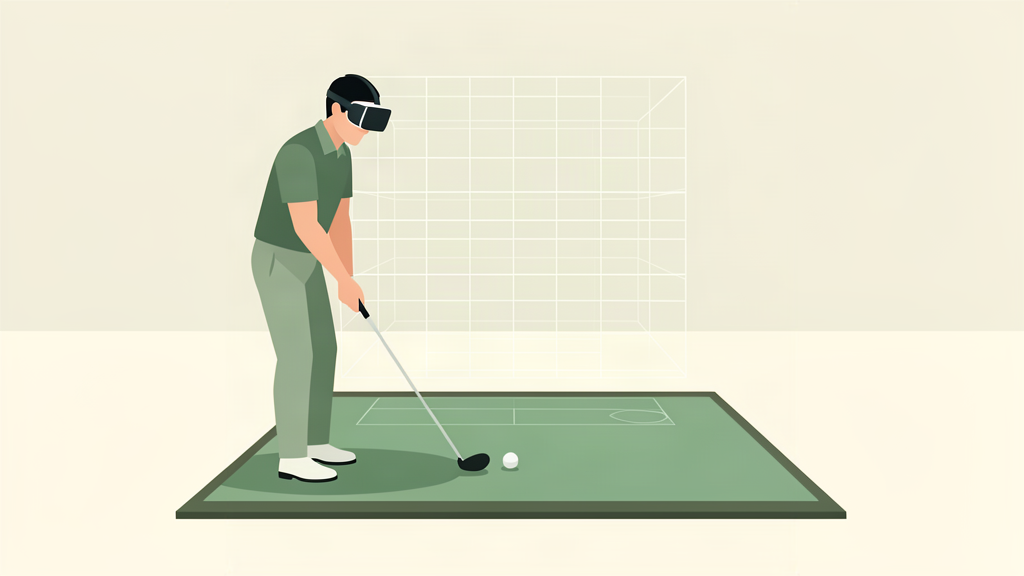
I spent a week hitting real golf balls with my real putter into a virtual green projected across my living room. Five hundred putts in seven days. My dog learned to sleep through it. My wife did not. And the honest answer to the question everyone asks is: yes, it transfers. But not the part you think.
Two tiny mixed-reality apps are the ones worth your money: Putt Dojo and PutterVR. Both track your actual ball and actual putter, and they solve the one thing almost every putting aid fails at, giving you hundreds of reps with instant feedback without changing the feel of your stroke. The golf industry just noticed VR and got it backwards. Most VR golf is controller-based games like Golf+ that teach course management, not putting, and I covered those separately. Putt Dojo fixes your start line for fifteen bucks, and PutterVR gives you tour-level data for forty. Neither one teaches you green-speed feel.
What VR Putting Improves, and What It Can’t
Both apps track your real ball for the first few inches of its roll, read its true direction and speed, then hand the rest off to a simulated green. That means the first thing that happens is real. Everything after is math.
So it improves three things. Start line. The ball leaves your putter for real, and the app tells you instantly whether it started on your intended line. You get more start-line feedback in one evening than a month of self-judged practice. Distance-control reps. Ladder drills and progressive-distance games give you hundreds of putts at specific lengths, which is exactly the volume a putting mat gives you plus the feedback a mat can’t. A repeatable stroke. Because you’re holding your real putter with its real weight, the physical motion is the same one you take to the course.
It cannot teach two things. Green-speed feel. A virtual green at stimp 10 is not your local bentgrass at 11.5 after a morning mow. The break and the final 90% of the roll are simulated, so your hands never learn what a real downhill four-footer actually feels like. Reading real grain and slope. A screen shows you the break; it doesn’t make you feel it. Treat these apps as a start-line and volume trainer, not a replacement for the practice green.
The Hardware: Quest 3S vs Quest 3
You need a Meta Quest headset, and it has to be a 3-series for these apps. The Quest 2 works for PutterVR but not for Putt Dojo, which needs the passthrough cameras on the 3 and 3S.
Meta Quest 3S (128GB), $348. Runs both apps fine and shares the Quest 3’s processor. Lower resolution and Fresnel lenses mean a smaller clarity sweet spot, but for putting you’re looking at a ball on the floor, not reading fine text. The cheapest way in.
Meta Quest 3 (512GB), $599. Better lenses and higher resolution, plus mixed-reality passthrough that’s sharper. For putting, the 3S is plenty. Spend the extra $250 only if you’ll use the headset for other apps.
Putt Dojo: The Cheap One That Needs No Hardware ($14.99)
Putt Dojo is the app you may have seen under its old name, Putt Window. Same developer, same app, renamed. It tracks your real ball with the Quest’s passthrough cameras using computer vision, which means no controller, no mount, no attachment of any kind. You put on the headset, place a real ball on a carpet or mat that contrasts with it, and putt. Hand tracking runs the menus.
What works: at $14.99 it’s the cheapest way to test whether real-ball VR putting does anything for you, and it’s a one-time purchase with no subscription. The four modes (Endless greens, Practice, Ladder Drill, One Putt Challenge) cover start-line and distance work. Reviews sit at 4.5 stars across 39 ratings, and the practical ones read like real golfers: one owner says he went from 70% to routine 20-in-a-row on 8-footers after a weekend.
What doesn’t: it’s early access, one indie developer, and the graphics are functional rather than pretty. It needs good lighting and a ball that contrasts with the surface, so a white ball on white carpet tracks poorly. And it only works on Quest 3 and 3S, not the Quest 2.
Buy this if you want the cheapest, simplest test of real-ball VR putting with zero extra hardware. Skip if you want structured analytics.
PutterVR: The Data-Heavy One ($39.99)
PutterVR is the newer, more ambitious app, released on the Meta store in mid-August 2026. It reads your real ball in “launch monitor” mode with no mount needed, and adds full mixed-reality and VR modes that require a controller mount sold separately on puttervr.com.
What works: the analytics are the draw. After every putt you get face angle, path, speed, and impact point, plus miss-pattern heat maps. It ships replica greens of championship courses and built-in training aids like an alignment laser, tempo line, and putting mirror. If you want a putting lab instead of a game, this is closer to it. It also runs on the Quest 2, which Putt Dojo does not.
What doesn’t: $39.99 is nearly three times Putt Dojo’s price, and it’s brand new, with only 9 ratings on the store. The richer mixed-reality and VR modes need that extra mount, which is another purchase and another thing to keep track of. For a golfer who just wants to groove a start line, most of this depth is overkill.
Buy this if you want tour-style putting data and structured drills, and you don’t mind early-access rough edges. Skip if you want the cheapest honest test of the concept.
Head to Head
Price. Putt Dojo wins at $14.99 against PutterVR’s $39.99, and it needs no mount.
Setup and hardware. Putt Dojo wins. No controller, no mount, just a ball and a putter. PutterVR’s launch-monitor mode is equally simple, but its best features live behind the mount.
Data and depth. PutterVR wins clearly. Face angle, path, smash factor, heat maps, championship greens. Putt Dojo keeps it to start line and distance.
Maturity. Putt Dojo wins on track record, with 39 reviews and two years of early-access updates versus PutterVR’s 9 reviews in two weeks. Neither is a polished product.
Who it’s for. Putt Dojo is for the golfer who wants to test the idea for fifteen bucks and fix a start line. PutterVR is for the data nerd who wants a putting lab and is fine paying for it.
What I Would Actually Buy
If you already own a Quest 3 or 3S: buy Putt Dojo for $14.99 first. It’s the cheapest way to learn whether real-ball VR putting does anything for your game, and it needs no extra gear. If you love it and want data, upgrade to PutterVR at $39.99 later.
If you need a headset: the Quest 3S at $348 plus Putt Dojo at $14.99 puts you in for $363. That’s three rounds of real golf for a putting trainer you can use every night in the winter. If you already own a quality putting mat, the headset is the better add than a second mat, because it adds start-line feedback the mat can’t give.
The honest ceiling: these apps sharpen your start line and give you reps. They will not teach you green-speed feel. Pair them with a real putting mat for speed and a monthly trip to an actual practice green, and you get the best of both. Buy VR putting as a supplement, not a replacement.
Where to Buy
- Meta Quest 3S (128GB) $348 at Amazon
- Meta Quest 3 (512GB) $599 at Amazon
- Putt Dojo $14.99 on the Meta Quest Store
- PutterVR $39.99 on the Meta Quest Store
Putt Dojo and PutterVR are digital downloads on the Meta Quest Store and are not sold on Amazon. GTD does not earn commission on those purchases. The PutterVR controller mount is sold separately at puttervr.com.