reviews
The Orange Whip Trainer: $119 for Better Tempo or Just an Expensive Stick?
I spent two years ignoring the Orange Whip. Every golf shop I walked into had one propped up by the register, and every time I picked it up, I put it right back down. $119 for a flexible stick with an orange ball on the end? I already owned a half-dozen training aids collecting dust in my garage. I did not need another one.
I was wrong.
My swing tempo has been a disaster for years. I rush the transition at the top, fire from the outside, and hit a 25-yard slice with my driver. My instructor kept telling me to “feel the pause.” I nodded like I understood. I did not understand. I could not feel a pause because I did not know what one felt like.
The Orange Whip taught me in about ten minutes.
What It Is
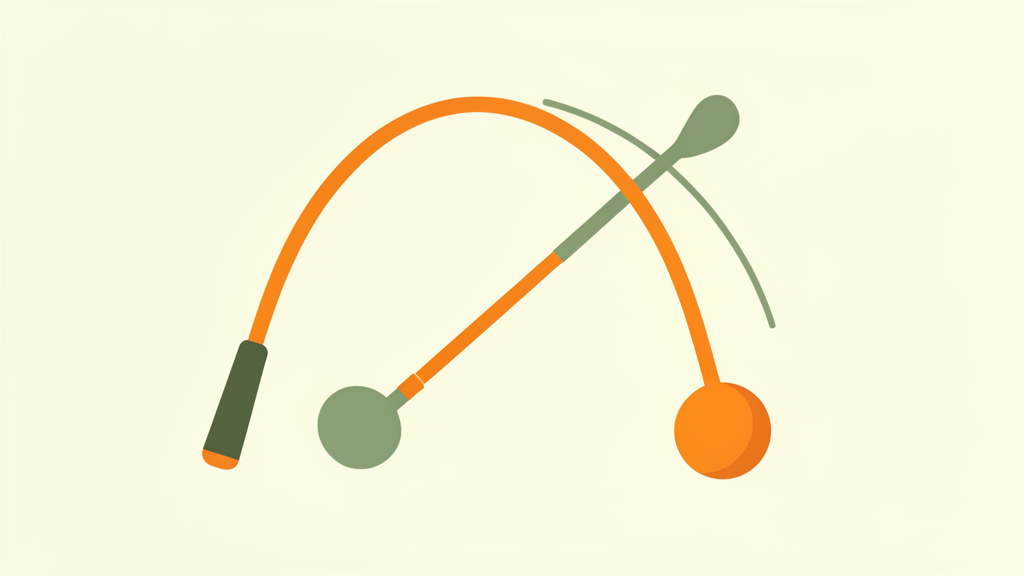
The Orange Whip Trainer is a 47.5-inch flexible shaft with a weighted orange ball on one end and a smaller counterweight on the grip. It weighs 1.75 pounds, roughly the weight of two drivers. Patented design, made in the USA.
The concept is simple on purpose. The flexible shaft and counterbalance force your body to swing in sequence. If you try to muscle it with your arms, the whip wobbles and the orange ball goes sideways. If your tempo is smooth and your body rotates properly, the ball traces a clean arc and you feel almost nothing at the top.
There is also the Orange Whip Golden, which runs $119 to $129 and weighs more. That one is built for low handicappers who want extra resistance and strength work. I have not tried it. The standard trainer is plenty for me.
The First Swing
I unboxed it in my living room. First mistake. This thing is nearly four feet long and weighs almost two pounds. I nearly took out a lamp on the backswing. Take it outside. Trust me.
The first few swings felt awkward. The weight surprised me. I am a 15-handicap who plays twice a week, and after ten minutes of continuous swings, my forearms and shoulders were genuinely sore. I did not expect a warm-up trainer to double as a workout.
But by swing number fifteen or twenty, I started feeling something I had never felt before. A natural pause at the top of the swing. The weighted ball reaches the end of its arc, momentum gathers, and then it starts down on its own. You do not have to pull it. You just let it fall.
That is the pause my instructor was talking about.
The Routine That Fixed My Tempo
I started using it every morning. Ten minutes, five days a week. Here is what I did.
I would swing the Orange Whip continuously back and forth, trying to keep the orange ball tracing the same arc on both sides. No stopping. No thinking about positions. Just rhythm. Then I would pick up my actual 7-iron and hit five balls into the net in my backyard.
The difference was immediate. My 7-iron swing felt smoother. The transition was slower. I was not lunging at the ball from the top. My driver slice, which had been a 25-yard banana, turned into a manageable 8-yard fade over the course of about three weeks.
I am not telling you the Orange Whip cured my slice. It did not. My grip and path still need work. What it did was give me the tempo to actually work on those things without my swing falling apart every third shot.
What Real Users Say
I am not the only one. Scroll through golf forums and the same patterns show up everywhere.
Most users agree it is excellent for warm-up and tempo. One Reddit poster put it perfectly: “They are useful for developing a feel for good tempo in a swing and for stretching and warming up. I don’t think they do much for swing speed.”
That last part is important. The Orange Whip will not add distance. If you want clubhead speed, buy a Rypstick ($199) or a SuperSpeed Golf system ($140).
Some instructors caution against using it for partial swings or wedge work. The flexible shaft makes it hard to feel proper lag and wrist angles on shorter shots. I agree. Use it for full swings and warm-ups. Leave the short game practice to something else. (It is also the single most-packed item in my tournament warm-up bag: ten slow swings before the first tee beats any swing thought.)
A few users complained about the price. $119 to $129 for the standard trainer is not cheap. The SKLZ Gold Flex does something similar for $40 to $65. I have tried both. The Gold Flex is lighter, the shaft is less flexible, and the feedback is noticeably weaker. You get what you pay for here.
What I Did Not Like
It gives you zero data. No metrics. No numbers. Just feel. If you are the type who wants to see your swing speed measured to the decimal, this will frustrate you.
You cannot hit balls with it. Unlike the Lag Shot 7-Iron ($129), which has a clubhead and lets you hit actual golf balls, the Orange Whip is swing-only. You swing it, then switch to a real club. That back-and-forth works, but it is an extra step.
The original 47.5-inch model is awkward to travel with. It does not fit in a standard golf bag easily. If you want something portable, look at the Orange Whip Compact (35.5 inches) or the LightSpeed model ($99).
The Verdict
If you are a 15 to 25 handicap who rushes the transition, fights a slice, and has zero feel for tempo, the Orange Whip is worth every penny of $119. It is the single best tool I have found for learning what a smooth swing transition actually feels like.
If you are a single-digit handicap looking for speed or distance, skip it. The Orange Whip Golden at $119 might be worth a look for strength and resistance, but you are better off with a dedicated speed trainer.
Here is what I would do. Buy the standard Orange Whip Trainer for $119. Use it for ten minutes every morning. Swing it back and forth until the rhythm feels natural. Then pick up a real club and hit five balls. Do that for two weeks.
My slice went from a 25-yard banana to an 8-yard fade. My transition went from a lunge to something that almost resembles a golf swing. My wife said my swing “looks different now.” She does not play golf. She could still tell.
That is $119 well spent.
Where to Buy
- Orange Whip Trainer — $119-$129 at Amazon
- Orange Whip Golden — $119-$129 at Amazon
- SuperSpeed Golf — $140 at Amazon
- SKLZ Gold Flex — $40-$65 at Amazon
- Lag Shot 7-Iron — $129-$149 at Amazon
Prices updated September 2026. As an Amazon Associate we earn from qualifying purchases.