guides
Golf Simulator Room Dimensions: Specs Lie by 2-3 ft
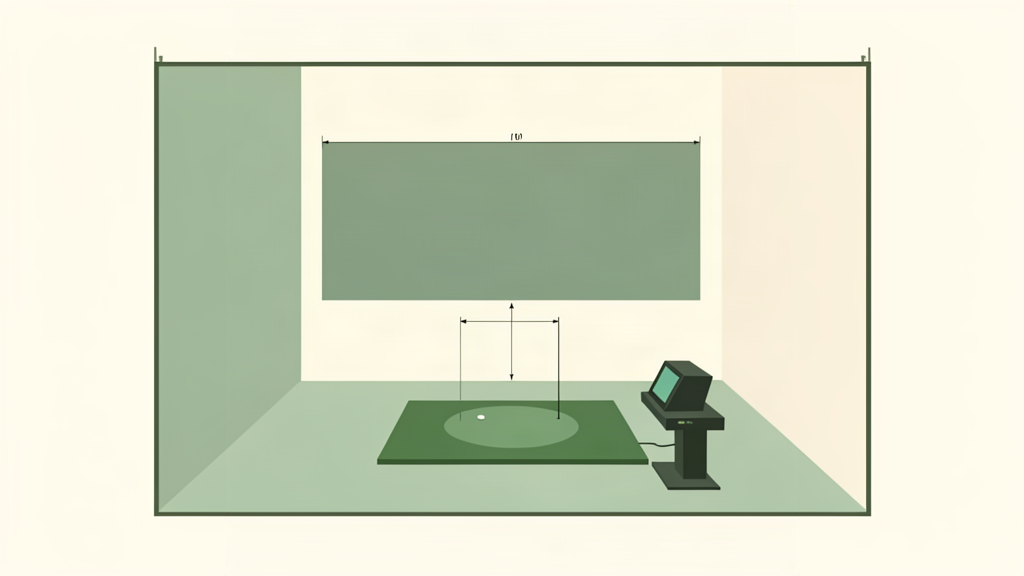
If your simulator room is under 18 feet deep and you bought a radar launch monitor, return it. I am telling you this because manufacturer spec sheets will not. They understate the depth you need by 2-3 feet, measuring the hardware instead of a human swinging a 45-inch driver.
The real minimums are below.
The Three Dimensions That Matter
Ceiling height: Can you swing a driver without hitting the ceiling? This is the dealbreaker. If your ceiling is under 8.5 feet, stop reading. You cannot build a full-swing simulator in that room. Chipping and putting only.
Room width: Can you swing without hitting the wall, and can a left-handed golfer play too? Width is where most builds fail the second-player test.
Room depth: The distance from the screen to the back wall. This is where manufacturers lie. They quote the minimum depth for the hardware. You need the minimum depth for a full driver swing plus follow-through plus safety buffer.
Ceiling Height: The Hard Stop
Minimum: 9 feet. You can get away with 8.5 feet if you are under 5-foot-10 and swing flat. Anyone taller or steeper will hit the ceiling with a driver.
Comfortable: 10 feet. Any golfer, any swing, any driver. No anxiety on the follow-through.
Ideal: 12+ feet. Full wedge swings. Flop shots. No thought about the ceiling at all.
Measure from the floor to the lowest obstruction: exposed beams, garage door tracks, light fixtures. Not the ceiling itself. The obstruction. That garage door track at 8 feet ruins your sim even if the ceiling above it is 10 feet.
Room Width: The Left-Handed Trap
Minimum: 10 feet. This gives you about 2 feet of clearance on each side at center. Tight but workable if you never have a left-handed guest.
Comfortable: 12 feet. Room to swing without thinking about the wall. A left-handed golfer can stand on the opposite side of the mat without crowding you.
Ideal: 14+ feet. Off-center hitting. Two players can share the space without tripping over each other’s bags.
The left-handed trap: most sim builders are right-handed. They center the hitting mat, set the launch monitor on the right side, and everything works perfectly. Then a left-handed friend comes over and has nowhere to stand. The launch monitor is in their way. The mat is oriented backward for their stance. Plan for this from the start. If you have left-handed friends, add 2 feet to your width budget.
Room Depth: Where Manufacturers Lie
Radar-based launch monitors (Garmin R10, FlightScope Mevo, Rapsodo MLM) need space behind the ball. Camera-based monitors (Rapsodo MLM2PRO, Bushnell Launch Pro, SkyTrak+) do not. This is the single biggest variable in your depth requirement.
Radar Monitors: 18-22 Feet Total
A radar launch monitor sits 6-8 feet behind the ball. Add your swing zone (7-8 feet from ball to back wall for a full driver swing with follow-through), the hitting zone (ball to screen, typically 8-10 feet), and a 2-foot safety buffer between the screen and the wall behind it.
The math: 7 feet (radar behind ball) + 8 feet (swing zone) + 9 feet (ball to screen) + 2 feet (screen buffer) = 26 feet total. But most radar monitors work at 6 feet behind the ball if your room is tight, and the swing zone shrinks to 7 feet for irons.
Realistic minimum for radar: 18 feet. You will only hit irons. The driver follow-through will feel tight. Comfortable: 22 feet.
Specific radar requirements:
| Monitor | Behind Ball | Total Depth (Minimum) |
|---|---|---|
| Garmin R10 | 6-8 ft | 18 ft |
| Rapsodo MLM | 6-8 ft | 18 ft |
| FlightScope Mevo | 4-7 ft | 16 ft |
| Swing Caddie SC300i | 5 ft | 15 ft |
Camera Monitors: 14-18 Feet Total
Camera-based monitors sit next to or slightly behind the ball, not 6-8 feet back. The depth comes almost entirely from your swing zone and the ball-to-screen distance.
The math: 2 feet (monitor beside ball) + 8 feet (swing zone) + 9 feet (ball to screen) + 2 feet (screen buffer) = 21 feet. But the swing zone is the main variable.
Realistic minimum for camera: 14 feet. Comfortable: 18 feet.
Specific camera requirements:
| Monitor | Behind Ball | Total Depth (Minimum) |
|---|---|---|
| Rapsodo MLM2PRO | 0 ft (side) | 14 ft |
| Bushnell Launch Pro | 0 ft (side) | 14 ft |
| SkyTrak+ | 0 ft (side) | 14 ft |
| FlightScope Mevo+ | 7-8 ft (radar) | 20 ft |
Note the Mevo+: it is a radar unit. It belongs in the radar column, not the camera column. The spec sheets show it next to the ball in some diagrams, but it actually needs 7-8 feet behind the ball to read spin accurately.
The Enclosure Factor
The enclosure itself eats space. A standard Carl’s Place DIY enclosure is about 2 feet deep. The screen sits at the front of the enclosure, so your ball-to-screen distance includes the enclosure depth in the room.
If your room is 16 feet deep and you install an enclosure that is 2 feet deep, you now have 14 feet of usable space. Measure the room first, then subtract the enclosure depth, then check the numbers above.
Can Your Room Work? Quick Test
-
Measure ceiling height at the lowest obstruction. Under 8.5 feet? No full-swing simulator. 9-10 feet? Monitor your driver follow-through. 10+ feet? Good to go.
-
Measure room width at the hitting position. Under 10 feet? One right-handed player only. 10-12 feet? Tight but workable. 12+ feet? Comfortable for lefties too.
-
Measure room depth from the wall behind the screen to the back wall. Under 14 feet? Camera monitor only, irons only. 14-18 feet? Camera monitor, full swing. 18-22 feet? Radar monitor, full swing. 22+ feet? Any setup, any club, no compromise.
-
Subtract 2 feet for the enclosure. If your depth is 16 feet and you want a Carl’s Place enclosure, your usable depth is 14 feet. Camera monitor only.
What I Would Do
I have a 20-foot-deep, 12-foot-wide garage with 10-foot ceilings. I run a camera-based launch monitor (Rapsodo MLM2PRO) at 9 feet from the screen with room to spare. A radar monitor would fit but the extra 6-8 feet behind the ball would push my hitting mat awkwardly close to the garage door.
If I had 22+ feet of depth, I would buy a radar monitor. The data is better. The Garmin R10 at $500 gives you simulator golf and club data that camera monitors at $700+ do not. But the depth requirement is real. Do not buy a radar monitor for a 14-foot room. You will hit your driver into the back wall, and the monitor will not read spin because it is too close to the ball.
Where to Buy
- Garmin Approach R10 $500 at Amazon.
- Rapsodo MLM $200 at Amazon.
- Rapsodo MLM2PRO $600 at Amazon.
- Carl’s Place DIY Enclosure from $999 at Amazon.
Measure your room three times before you buy anything. Measure at different points. The floor might slope. The ceiling might vary. Write down the smallest number in each dimension. That is your real spec. Everything else is marketing.