guides
Best Golf Glasses for Progressive Lenses: The $40 Fix
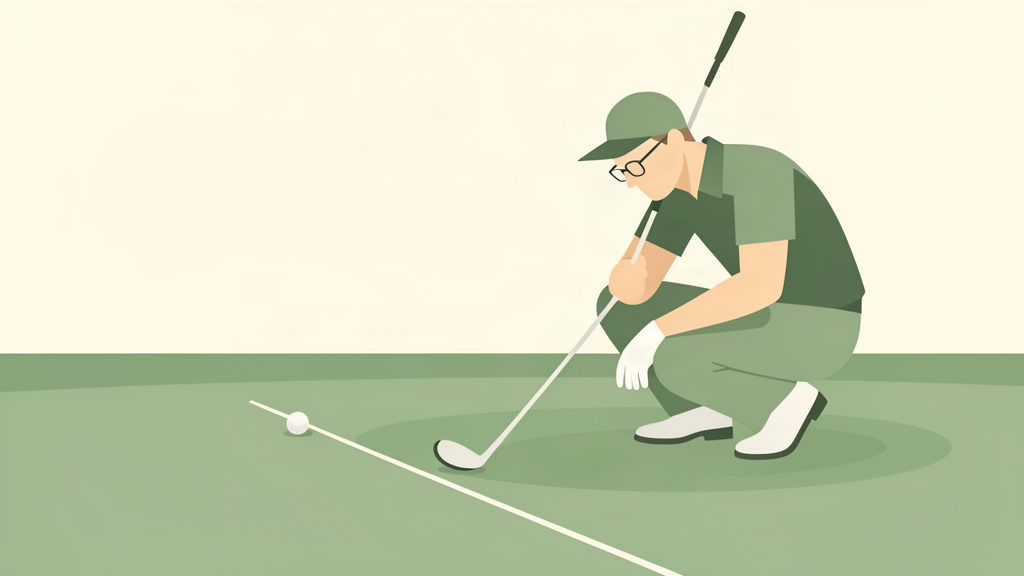
The thing throwing off your alignment is already on your face. No $600 driver will fix it.
If you wear progressive or bifocal lenses, you already know the frustration. The ball looks sharp one second and fuzzy the next. You catch yourself tilting your chin up to find the ball at address, then your neck hurts on the back nine. You read a putt as breaking left and it breaks right. There are multi-year threads on GolfWRX and MyGolfSpy full of golfers over 50 describing exactly this, and the answer they keep landing on is not a swing fix. It is a second pair of glasses.
A progressive lens splits your vision into distance, intermediate, and reading zones, and the boundary between them lands right in the middle of the ball. Your eye hunts for the right zone, your head moves, and your setup shifts every single time. The fix is not a swing change. It is what you put on your face.
This guide is for golfers 50 and up who wear progressives or bifocals and are tired of fighting their own prescription. It covers single-vision golf glasses, prescription sunglasses, fit-overs, and clip-ons, ranked by what actually solves the problem. If your issue is color, not focus, that is a different article (colorblind green reading). This is about focal length.
The Picks, Ranked
1. Single-Vision Distance Glasses: The Actual Fix ($30–$70)
The single best thing you can do for your golf game is order a cheap pair of single-vision distance glasses and wear them only for golf.
A single-vision distance lens has one prescription across the entire surface. No reading zone, no intermediate zone, no boundary line. When you look down at the ball, the ball is in focus. When you look up at the target, the target is in focus. Your head stays still because your eye is not hunting for a zone. The whole “lower your chin” workaround disappears because there is no boundary to dodge.
The best part is the price. Zenni Optical sells single-vision distance glasses with frames and lenses starting around $30, and a decent pair lands around $50 to $70. For the cost of a round of golf, you get a pair that fixes a problem no $600 driver will touch. Wear them for golf and keep the progressives for everything else.
What does not work: you give up near vision while wearing them. Reading a scorecard or your phone means taking them off or peeking under the lens. That is the trade, and for most golfers it is an easy one.
Buy this first. It is the cheapest fix and the one that actually solves the problem.
2. Prescription Golf Sunglasses (SportRx): The Sport-Frame Fix ($174+)
If you want the same single-vision fix in a sport frame with golf-specific tint, that is exactly what SportRx builds. They make prescription golf sunglasses with single-vision distance lenses, and their entry models start around $174 with free single-vision lenses on eligible frames.
The advantage over Zenni is the frame. SportRx frames are built for the course: wrap-around coverage, secure fit, and lens tints tuned for reading greens. You get the focal-length fix and the sun protection in one package.
What does not work: the price. $174 and up is real money, and if you are not sure you will stick with single-vision golf glasses, start with the $40 Zenni pair and upgrade later.
Buy this if you play in bright sun often and want one pair that does everything.
3. Non-Prescription Golf Sunglasses: For Contact Lens Wearers ($30–$180)
If you wear contact lenses on the course, the focal-length problem is already solved and you only need tint. This is where the two names that matter live.
The Oakley Flak 2.0 XL with Prizm Golf lenses runs roughly $170 to $210. Prizm Golf is genuinely tuned to make a golf ball stand out against grass, and it is the gold standard for a reason. The budget alternative is Tifosi, whose golf sunglasses run $25 to $50 and do 80 percent of the job for a quarter of the price.
What does not work: neither fixes focal length, because they assume your prescription is handled by contacts. If your contacts dry out mid-round or your distance vision is not crisp in them, you are back to the same problem.
Buy this if you already wear contacts and just need sun protection.
4. Cocoons Fit-Over Sunglasses: Tint Without New Glasses ($40–$70)
Cocoons are polarized sunglasses built to fit over your existing prescription glasses. If you refuse to give up your progressives and just want glare protection, this is the move. Polarized lenses cut the glare that makes it hard to track a ball against the sky, and they sit over whatever you already wear.
What does not work, and this matters: they do not fix the focal-length problem. Your progressives are still under there, boundary and all. Cocoons solve glare, not focus. Buy them for brightness, not as a cure for the setup problem.
Buy this if glare is your only complaint and you want to keep wearing your progressives.
5. Clip-On Flip-Up Sunglasses: The $15 Budget Option
Flip-up polarized clip-ons run $10 to $20 on Amazon and clip onto your existing frames. They flip up when you do not need them and down when the sun is in your eyes.
What does not work: same caveat as the Cocoons, plus they add bulk and can scratch your lenses if you are not careful. They are a glare fix, not a focal fix, and the cheapest ones rattle.
Buy this if you want to spend as little as possible to cut glare and that is all.
What About Contact Lenses
The cleanest workaround for some golfers is a pair of distance-only contact lenses worn just for golf. No glasses on your face, no boundary, no tint issues. The catch is comfort, cost, and the fact that contacts do not help if your distance vision is not crisp enough in the first place. Worth asking your optometrist about, but it is not the first thing to try.
What I Would Actually Buy
Start cheap. Order a $40 to $70 pair of single-vision distance glasses from Zenni and play three rounds. If your ball position feels steadier and your neck stops hurting, you have found the fix for the price of a dozen Pro V1s.
If you play in bright sun, upgrade to the SportRx prescription sunglasses at $174 or more, and keep the Zenni pair as a backup.
If you already wear contacts, the Tifosi at $25 to $50 is the smart money, and the Oakley Prizm Golf at $170 to $210 is the splurge.
Skip the fit-overs and clip-ons if your real problem is the focal-length boundary. They cut glare, not blur.
The golf industry would rather sell you a new driver than admit the fix was a $40 pair of glasses. Your swing is not broken. Your prescription is.
Where to Buy:
- Single-Vision Distance Glasses (Zenni) $30–$70 at Zenni (direct, no affiliate)
- Prescription Golf Sunglasses (SportRx) from $174 at SportRx (direct, no affiliate)
- Oakley Flak 2.0 XL Prizm Golf $170–$210 at Amazon
- Tifosi Golf Sunglasses $25–$50 at Amazon
- Cocoons Fit-Over Sunglasses $40–$70 at Amazon
- Clip-On Flip-Up Sunglasses $10–$20 at Amazon
Zenni and SportRx sell prescription lenses direct and are not available on Amazon; links go to their sites. As an Amazon Associate we earn from qualifying purchases.