guides
Camera vs Radar Launch Monitor: Room Decides, from $199
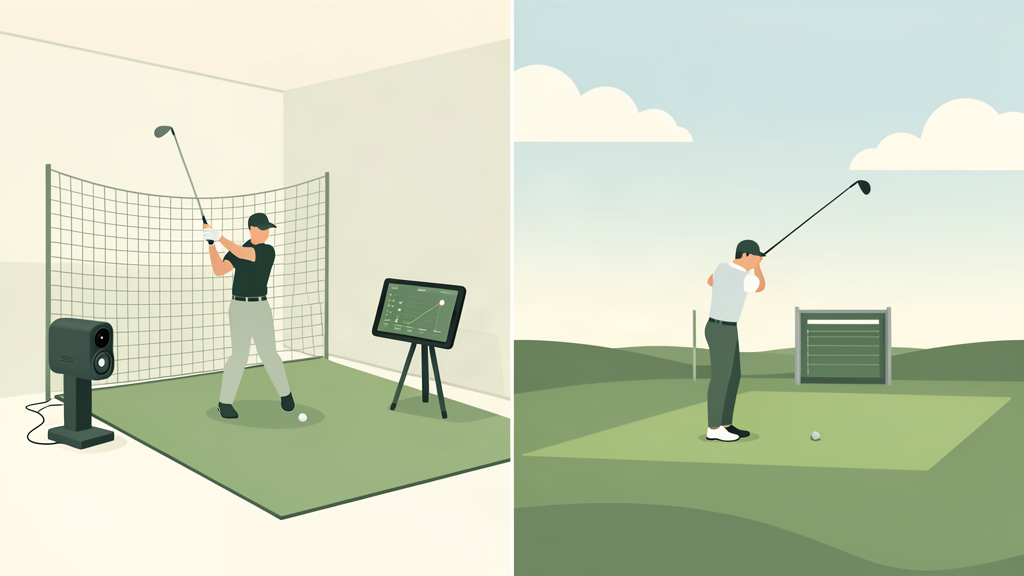
The question most golfers ask about launch monitors is the wrong one. They ask which brand to buy before they ask which technology works in the room they will actually swing in. Then they spend $600 on a radar unit, set it up in a spare bedroom with six feet of clearance, and wonder why their spin numbers are fiction.
The fork between camera and radar is not a tech-spec argument. It is a floor-plan argument. Radar reads the ball in flight, so it needs space behind the ball and room for the ball to fly. Camera photographs the ball at impact, so it needs almost no space at all. Your garage or spare room has already made this decision for you. You just have not checked yet.
In 2010 this argument barely existed, because the only camera units sat in $15,000 fitting bays and the only radar unit anyone could afford was a $25,000 TrackMan. In 2026 both technologies start under $700. The industry now sells them interchangeably, as if they were the same product in different colors. They are not. One measures ball flight, the other photographs impact. That single difference decides which one belongs in your room.
How the Two Technologies Actually Work
A radar launch monitor sits behind the ball and bounces microwaves off it as it flies. It reads the ball’s real flight, which is why radar is brilliant outdoors and at the range. It is also why radar struggles indoors. To read spin indoors, the ball needs enough flight to complete a few revolutions, and the unit needs enough space behind the ball to see it cleanly. The Garmin Approach R10 wants about six feet behind the ball. The FlightScope Mevo+ wants seven to eight. Shorten that, and the radar stops measuring spin and starts guessing it with a machine-learning model.
A camera launch monitor sits beside the ball and photographs the instant of impact at thousands of frames per second. It reads the ball and clubface from the photos, so it does not need the ball to fly at all. This is why camera units own the indoor simulator market. The tradeoff is a small hitting zone: the ball has to sit in the exact spot the cameras are aimed at, with the right lighting and markings.
There is a second distinction hiding under the hood, and it is the most useful thing to understand about radar. Some of the R10’s numbers are radar-measured and some are algorithm-calculated. Club head speed, ball speed, launch angle, and launch direction are measured directly. Club face angle, apex height, and carry distance are calculated from those measurements. That is fine for most golfers, but it means the R10’s path and face data are directional hints, not fitting-grade numbers. Camera units photograph the actual impact, so more of their output is measured and less is inferred.
The one number that separates the two technologies is spin. Radar measures spin by watching the ball fly, and below about 90 mph of ball speed, which covers most women and a lot of seniors, radar stops reading it accurately and falls back on estimation. Camera measures spin from the impact photos, so it works at any speed. That single fact is the difference between a launch monitor that tells you the truth indoors and one that tells you a polite guess.
Spin is where radar makes its quiet compromises, and it is worth knowing the workarounds before you buy. Indoors, the R10 and Mevo+ can read spin if you use marked balls: Titleist RCT balls with the metallic dot for radar, or Rapsodo RPT balls for the MLM2PRO. Those balls cost more than a standard sleeve, but they are the difference between a real spin number and a guess. If your monitor will live mostly indoors, factor a few dozen marked balls into the budget, or buy a camera unit that does not need them. And if you are a woman or a senior whose ball speed sits under that 90 mph line, read my best launch monitors for women guide before you buy anything, because the spin gap hits your game hardest.
The Fork: Match the Technology to Your Space
If you practice outdoors or at the range, buy radar. Set it down, align it, swing. It tracks the full flight, works with range balls, and needs no markings on the ball. If you are building an indoor simulator or hitting into a net in a spare room, buy camera. No space behind the ball, no flight needed, accurate spin at any speed.
That is the whole decision, and it is honest. I covered the full radar field in my best launch monitors under $1,000 guide and the step up in my prosumer launch monitor guide. Neither of those pieces asks the question this one does, which is which kind of monitor belongs in your actual room.
Radar Picks, From $199 to $2,199
The Rapsodo MLM ($199) is the cheapest real entry. It is iOS only and outdoor only, and it gives you six basic metrics. Buy it only if $200 is a hard limit and you always practice outside.
The Garmin Approach R10 ($499) is the value pick. It reads 15 data points, doubles as a simulator through E6 Connect and Home Tee Hero, and its ball speed and carry distance land within a few units of a $25,000 TrackMan. The honest caveat is the one above: path and face angle are estimates, and indoor spin is guessed unless you use Titleist RCT balls with the metallic dots.
The Rapsodo MLM2PRO ($599) is the bridge case. It pairs radar with two cameras, so it works indoors and out, and it measures spin directly when you use the special RPT balls. The catch is a $199 a year subscription that unlocks most of what makes it good.
The Swing Caddie SC300i ($399) and SC4 Pro ($499) are the no-phone options, with a built-in screen and a voice that reads your carry distance aloud. The SC4 Pro adds simulator play. Neither gives you lateral direction data, so they are range tools, not swing-analysis tools. For seniors who want no pairing and no reading glasses, the SC300i is the pick.
FlightScope Mevo is discontinued, but preowned units around $300 are the most accurate budget radar you can buy. The FlightScope Mevo+ ($2,199) is the prosumer jump: 16 data points, measured club path and face angle, no subscription, but it needs seven to eight feet of setup depth, which is tight in a single-car garage.
Camera Picks, From $700 to $3,499
The SkyTrak is the indoor standard. A refurbished SkyTrak OG runs $499.95 direct from SkyTrak, which is the single best deal in the category right now, 58% off the $1,195 list price. It reads ball data with real accuracy and needs almost no room.
The SkyTrak+ ($2,495) adds club data. The Bushnell Launch Pro ($1,999 and up) is photometric and sits three feet beside the ball, with ball speed accurate to within half a mph of a $15,000 GCQuad. The catch is a subscription model that has changed three times and can push the real cost past $3,000 with club data and simulator access. The Uneekor Eye Mini Lite ($1,999) is indoor only and photometric, and it is sold direct, not on Amazon.
Camera units are not a budget play. The floor is the SkyTrak at $500 refurbished, and the ceiling runs past $3,000 once you add club data. You buy a camera unit because you are building a simulator in a tight space, not because you want the cheapest monitor.
The Price Reality
Sticker prices lie in this category. The MLM2PRO looks like $599 but is really about $800 in year one once you add the subscription. The R10 is $499 once and nothing after. The Mevo+ is $2,199 with everything included. The Bushnell can push past $3,000 with club data and simulator subscriptions.
For a simulator in a small room, the honest budget is $500 for a refurbished SkyTrak, plus a net and mat. For outdoor range work, $499 buys the R10 and you are done. The technology you need is set by your space, and the price follows from there.
What I Would Actually Buy
If you hit balls at the range or in your yard, buy the Garmin R10 at $499. It is the best radar value and doubles as a simulator later.
If you are building an indoor setup in a spare room, buy a refurbished SkyTrak at $499.95 and do not look back. Camera technology is the only honest choice indoors, and the refurb deal is the best value in the category.
If you want one device that works both places, the MLM2PRO at $599 is the bridge, but budget for the subscription.
The one purchase to avoid is a radar unit for a tight indoor room. You will spend $500 and get spin numbers that are guesses. Measure your space first, then buy the technology that fits it. The room decides, not your ego.
Where to Buy
- Garmin Approach R10 $499 at Amazon
- Rapsodo MLM $199 at Amazon
- Rapsodo MLM2PRO $599 at Amazon
- Swing Caddie SC4 Pro $499 at Amazon
- FlightScope Mevo+ $2,199 at Amazon
- SkyTrak Launch Monitor $499.95 refurbished at SkyTrak.com
- Bushnell Launch Pro $1,999 at Amazon
Prices verified August 2026. The Uneekor Eye Mini Lite ($1,999) is sold direct at uneekor.com, not on Amazon. As an Amazon Associate we earn from qualifying purchases.