guides
Best Short-Putt Aids: 5 I Tested, $15-$150
You do not need a $400 putting mat to make more three-footers. You need to make the three-footer you already face on every single hole. That is the whole problem, and most golfers attack it with the wrong tool.
A three-foot putt is not a distance-control problem. It is a start-line problem and a nerve problem. The face is one degree open and the ball misses two inches left. Or your hands get tight and you steer the putter and it wobbles off the line. Neither of those is fixed by a launch monitor or a $180 mat with adjustable slope.
I learned this the expensive way. I spent $200 on an expensive mat with adjustable break, and my three-footers did not get any better. The mat never told me why I was missing. It just gave me a nicer surface to miss on. What actually fixed the miss was a $20 gate that punished me every time my face was crooked.
The five aids below each fix one specific short-putt fault. Match the aid to your miss and you stop throwing away two to four strokes a round. The most expensive one is $150. Most are under $50.
Miss 1: You Miss Three-Footers Left or Right
The Problem
You line up a three-footer that looks dead straight. You miss it left. Or right. You have no idea why, and it starts getting in your head on the next hole.
The face of your putter is open or closed at impact. Not by much. One degree is enough to push a three-footer wide. You cannot feel one degree. You need a tool that shows it to you.
The Fix: EyeLine Putting Gates ($15-$30)
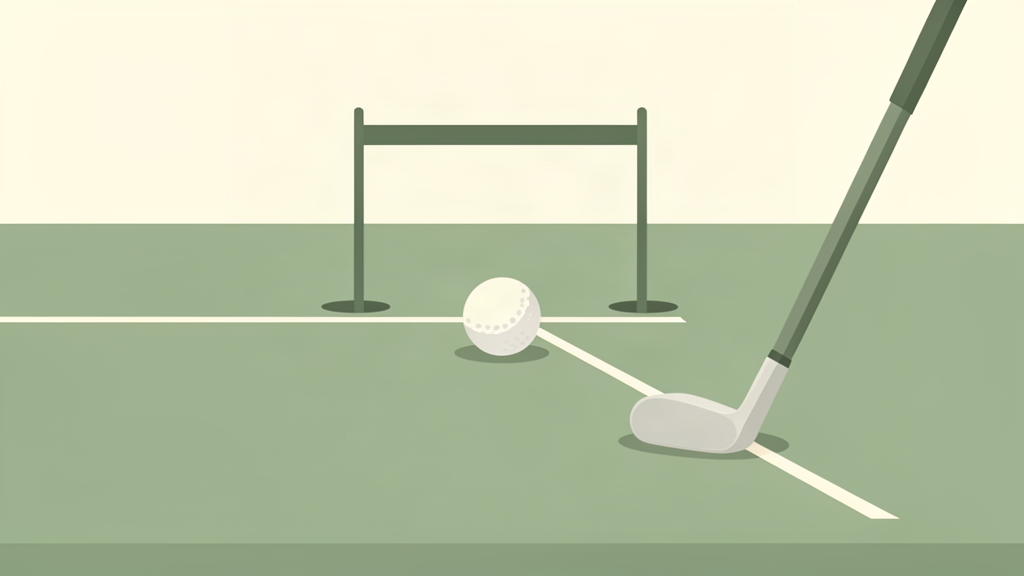
A set of small gates you place on the ground and roll your putter through. Set two of them just wider than your putter head and putt. If your face is square, the ball rolls clean through the middle. If the face is off, the putter or ball clips a gate and you know it instantly.
These are the cheapest start-line fix in golf. Under $25, and they punish a crooked face better than any mat. Set them up three feet from the hole and roll 20 putts. You will know within a day whether your miss is start line.
Skip: nothing at this price. If you want a gate that physically forces the path instead of just penalizing it, jump to the Visio below.
Also worth a look: the EyeLine mirror ($36) fixes eye alignment, which is often the root cause of the crooked face. If your face looks square to you but is actually open, your eyes are aimed wrong.
Miss 2: Your Eyes Are Not Over the Ball
The Problem
You think you are looking straight down at the ball. Your eyes are actually two inches inside the target line. That means the putter face that looks square to you is actually aimed left. You miss left every time and cannot figure out why.
Posture drift is real. As you age or get tired, your eye position changes. You cannot feel it happening.
The Fix: EyeLine Putting Alignment Mirror ($36)
A flat acrylic mirror with lines for your eyes, shoulders, and putter face. You stand over it, look down, and see exactly where your eyes sit. You cannot un-see it. The mirror also has gate slots for tee drills and a stroke guide. 2,600 Amazon reviews at 4.5 stars. Rory McIlroy uses one.
Five minutes before your round and your three-footers stop being a coin flip. This is the best $36 in short-putt practice.
Skip: the $15 KINGTOP knockoff. The gate slots are sometimes misaligned, and a crooked gate teaches a crooked stroke.
Also worth a look: the Visio Putting Mirror ($32) is $4 less but lacks the built-in gate slots. Spend the extra four bucks.
Miss 3: Your Putter Head Wobbles Off the Line
The Problem
You make solid contact and your pace feels fine. But the ball starts left or right of where you aimed and you cannot explain it. Your putter head is wobbling slightly off-path in the backswing, and you compensate by steering the face through impact. Sometimes it works. Sometimes it does not.
The Fix: Visio Adjustable Putting Gate ($47)
Two gates that sit on the ground, adjustable in width. You place the ball between them with just enough room for the putter to pass through. Hit a gate and you know your path is off. Widen the gap while you learn, narrow it as you improve. Phil Kenyon, one of the best putting coaches on tour, uses these with his students.
For a three-footer, path and face are the whole ballgame. The Visio gate gives you instant feedback on the path half of that equation.
Why not a mirror for this? A mirror shows your eye position. A gate shows your putter path. Different problems. If your three-footers feel like solid contact but still miss, you need the gate.
Miss 4: You Decelerate and Steer Under Pressure
The Problem
You make three-footers on the practice green and miss them on the course. The difference is not mechanics. It is nerve. When a putt matters, your hands get tight, you slow down through impact, and you steer the putter instead of swinging it. A steered putter misses.
The Fix: PuttOut Pressure Putt Trainer ($30)
A raised ramp with a micro-target about the size of a golf ball’s dimple. Hit the putt with a committed stroke and the ball rolls up the ramp and sticks in the cup. Hit it soft or offline and it rolls back to you. The feedback is instant and binary: you either made it or you did not.
This is the best $30 you can spend on short-putt confidence. It fits in your bag, works on any flat floor, and turns five minutes into thirty reps. The pass-fail feedback teaches you to commit through impact instead of steering. I keep one next to my desk and hit putts while I think.
Skip: the PuttOut AirBreak ($340). It simulates breaking putts and it is brilliant, but a three-footer rarely breaks enough to need a $340 machine. The $30 ramp covers it.
Miss 5: You Have No Real Target to Aim At
The Problem
You practice on a carpet seam or a coin on the floor, which is better than nothing and worse than a real hole. You need a flat surface with an actual small target so your short-putt practice transfers to the course.
The Fix: Perfect Practice Putting Mat ($110)
A roll-out mat with an auto ball return and two hole sizes. The half-size hole is the key for short putts. It is roughly half the width of a regulation cup, so a three-footer into the small hole forces you to hit a precise line. Make those consistently and a real cup looks huge.
The auto ball return means you never bend over, so you can knock out fifty three-footers in ten minutes. That repetition is what builds the nerve to make them on the course.
What to know: the magnetic ball return track has worn out on some units after six to twelve months of heavy use. Not every unit, but enough to mention. At $110 for the Compact it is still worth it for the practice volume.
Also worth a look: the Wellputt 10ft Start 2.0 ($89) has “Good Zone” pace markings, but it is aimed at distance control, not the three-footer. For strictly short putts, the half-size hole on the Perfect Practice wins.
The 10-Minute “Make More Three-Footers” Routine
Pick one aid, not all five. Most golfers need a gate and a mirror, then reps.
- Two minutes on the mirror to check eye position before every session.
- Set a gate three feet from the hole, just wider than your putter. Roll 20 putts through it. Clip a gate and start the count over.
- Move to the PuttOut ramp or the half-size hole and hit 20 committed putts. Do not steer. Commit to the line and hit it.
- Track how many of the last 10 you make. When you make nine out of ten from three feet for a week straight, the nerve problem is mostly gone.
The whole thing is ten minutes a day. That is less time than you spend waiting on the first tee. If your short putts are costing you strokes, this is a bigger fix than a new putter, and it costs under $110.
What I Would Actually Buy
If you only buy one thing, get the EyeLine Putting Gates ($20) plus the PuttOut Pressure Putt Trainer ($30). The gate tells you if your start line is crooked. The ramp builds the commitment to hit through it. Fifty bucks total.
The full short-putt setup ($86): gates ($20), EyeLine mirror ($36), and PuttOut ($30). Add the Perfect Practice mat ($110) when you want a real indoor target. That is $196 for everything, which is less than most golfers spend on a driver they do not need.
Skip the AirBreak ($340) unless you have already fixed start line and nerve and specifically need break practice. For the three-footer, you do not.
Where to Buy
- EyeLine Putting Gates $15-$30 at Amazon
- EyeLine Putting Alignment Mirror (Small) $36 at Amazon
- Visio Adjustable Putting Gate $47 at Amazon
- PuttOut Pressure Putt Trainer $30 at Amazon
- Perfect Practice Putting Mat (Compact 8’) $110 at Amazon
Golf Training Daily is reader-supported. When you buy through links on our site, we may earn an affiliate commission at no extra cost to you.
I stopped buying putting aids after the mirror and the gate. My three-footers went from a coin flip to a routine. The secret was never a better mat. It was finding out why I was missing, then practicing that one thing for ten minutes a day. Do that and you will not need to buy anything else.