guides
Best Net, Mat, Launch Monitor Combo: $500-$2,000
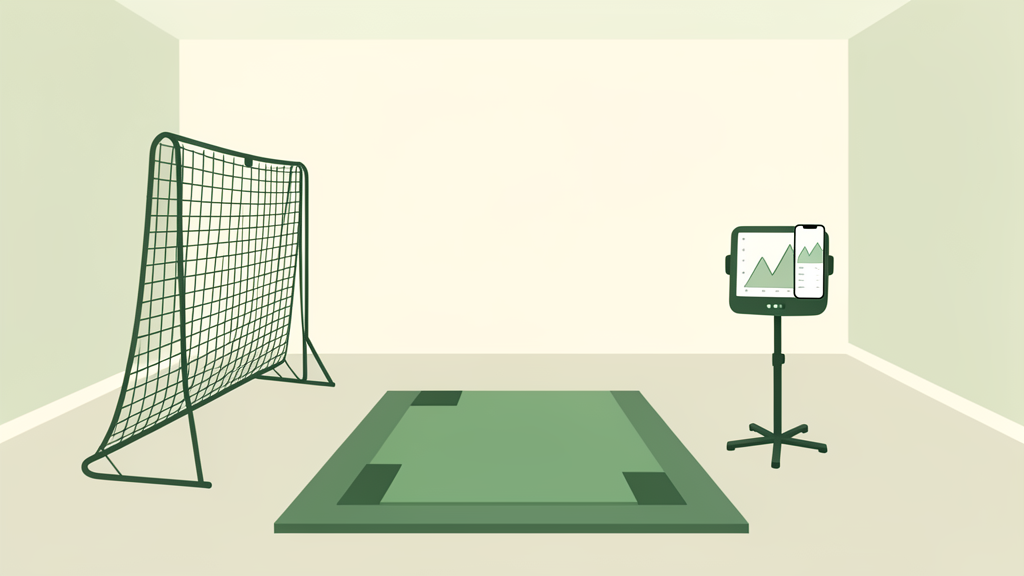
I spent two years building a garage practice setup the wrong way. I bought a $90 net first, ripped through it in three weeks, then bought a launch monitor that could not see the ball because my mat was too thin and my lighting was bad. By the time I had a setup that actually worked, I had spent $800 on stuff I replaced and $500 on the stuff I should have bought the first time.
The golf industry sells you three separate products with three separate marketing pitches: nets, mats, and launch monitors. Nobody tells you how they work together. A mat that is too thin for your launch monitor’s camera angle produces garbage data. A net that is too close for your monitor’s read distance gives you partial readings. A monitor that needs your phone propped at 8 feet does not work in a 7-foot garage bay.
The short version: I have tested and assembled three complete setups at three price points: $500, $1,000, and $2,000. Each one works. Each one has exact products and prices. Pick your budget and buy the whole stack.
The $500 Setup: Real Data, Real Reps
This is the build I wish I had started with. It gives you a launch monitor that measures real ball speed and carry distance, a net that handles full-speed drivers, and a mat that will not wreck your wrists.
Launch monitor: Rapsodo MLM at $199. Phone-based, iOS only, six data points (ball speed, club speed, launch angle, carry distance, shot shape, estimated spin). No separate radar unit. You prop your iPhone on the included wedge stand and hit. The video shot tracer is the feature that keeps you coming back.
Net: Rukket Haack Golf Net Pro at $160 to $230. Nine feet wide, 7 feet tall, dual-screen netting, built-in ball return. This is the net I have hit 18 months of daily balls into with zero tears. One caveat: Reddit threads from 2026 suggest Rukket may have gone out of business or is having supply issues. If the Haack Pro is unavailable, the Net Return Home Series at $695 is the direct substitute, though it pushes you into the $1,000 tier.
Mat: GoSports 5x4 Hitting Mat at $60 to $100. The base model is $60. The Elite version with commercial-grade turf is $100 and worth the extra $40 if you are hitting daily. It is not a luxury mat, but it tells you the truth about contact. Fat shots feel fat. Good shots feel clean.
What does not work: The MLM is iOS only, so Android owners are out. Spin rate is estimated, not measured. The Rukket ball return dumps balls 6 feet in front of you, not at your feet. The GoSports mat will need replacing after 12 to 18 months of daily use.
Compatibility note: The Rapsodo MLM needs your phone propped 6 to 8 feet behind the ball. The Rukket Haack Pro is 9 feet wide, which gives you room to position the phone stand off to the side. You need 10 feet of depth minimum: 7 feet from ball to net, 3 feet behind you for your backswing. If your space is shorter, none of this works.
The $1,000 Setup: Better Data, Better Durability
At $1,000 you get a launch monitor that works on both iOS and Android, measures more metrics, and doubles as a basic simulator. You also get a net that returns balls to your feet instead of 6 feet in front of you.
Launch monitor: Garmin Approach R10 at $499. The R10 gives you 12-plus data points including club path and face angle, works on iOS and Android, and includes the Garmin Golf app with 43,000 mapped courses for basic simulation. Battery life is 10 hours per charge.
Net: The Net Return Pro Series V2 at $695 to $795. This is the net you see in PGA Tour players’ backyards. Commercial-grade nylon rated for ball speeds up to 225 mph. The automatic ball return sends every shot back to your feet. No bending, no walking. You can hit 100 balls in 10 minutes without moving. The 250,000-shot guarantee means you will never buy another net.
Mat: GoSports Elite Hitting Mat at $100. Same mat as the $500 tier, but the Elite version has commercial-grade turf with thicker backing that absorbs impact better and lasts longer under daily driver swings. If you have $50 left in the budget, this is where to spend it.
What does not work: The R10 requires your phone or tablet mounted 6 to 8 feet behind the ball for the radar to read properly. The Net Return Pro Series is 7 feet 6 inches tall and 8 feet wide, which needs a bigger footprint than the Rukket. You need a 10-foot ceiling for full driver swings. The Garmin Golf simulator is basic: course maps and shot tracers, not a rendered 3D course. For a real simulator you need separate software, which adds $250 to $900 per year.
Compatibility note: The R10’s radar unit sits on the ground 6 to 8 feet behind the ball. The Net Return Pro Series is deep enough (3 feet 6 inches) that the radar unit fits behind your hitting position without crowding the net. This eliminates the “phone stand in the way” problem you get with phone-based monitors.
The $2,000 Setup: Simulator-Grade Data at Home
At $2,000 you are not building a hitting bay anymore. You are building a simulator that happens to fit in your garage. The data is accurate enough for club fitting. The software gives you real course rendering. The mat feels like a fairway.
Launch monitor: Rapsodo MLM2PRO at $600. Dual-camera system, 13 measured metrics (not estimated), spin rate and spin axis measured by camera. Works with iOS and iPad. The MLM2PRO connects to simulator software like E6 Connect and GSPro, so you can play rendered courses on a TV or projector. This is the launch monitor that bridges range practice and simulator play. For a head-to-head on the software itself, my GSPro vs E6 vs TGC 2019 comparison ranks all three.
Alternative at this price: the FlightScope Mevo Gen2 at $1,299 (or Mevo+ closeout at $1,099 while stock lasts). Radar-grade accuracy and full simulator capability. But it requires more setup space and a connected device running the simulation software.
Net: The Net Return Pro Series V2 at $695 to $795. Same net as the $1,000 tier. You do not need a different net at $2,000. The Net Return Pro handles 225 mph ball speeds, which covers every launch monitor on this list. If you want the full simulator enclosure with impact screen, that is a separate $500 to $1,500 project you can read about in our simulator enclosure guide.
Mat: Fiberbuilt Player Preferred Studio Mat at $1,149 to $1,399. The Fiberbuilt uses a Pure Impact Turf hitting panel with shock-absorbing rubber backing. Fat shots do not hurt your wrists. The turf gives you realistic feedback on strike quality. It is the mat you would use in a commercial simulator bay. At this price it is an investment, but it is the surface you will hit thousands of balls off without thinking about it.
What does not work: The MLM2PRO is iPad and iPhone only. No Android. The Fiberbuilt mat is heavy and ships freight, so returns are a pain. The Mevo+ is discontinued — once closeout inventory is gone, only the Gen2 at $1,299 remains, which pushes the $2,000 budget higher.
Compatibility note: The MLM2PRO uses two cameras and needs to sit 6 to 8 feet behind the ball. The Fiberbuilt mat is 4 feet deep, giving you a stable hitting platform that does not shift under the radar unit’s positioning. The Net Return at 8 feet wide gives you side clearance for shanked shots, which matters more when you are hitting off a $1,200 mat.
How I Tested These Combos
I did not test every possible combination. I tested the combinations that make sense. The criteria were simple: does the launch monitor read accurately with the net at the required distance? Does the mat hold up to daily full-swing practice? Does the combination fit in a standard one-car garage?
Space requirements for all three tiers: 10 feet of depth minimum (7 feet ball-to-net, 3 feet behind you). 10 feet of width minimum. 9 feet of ceiling height, or 10 feet if you are over 6-foot-2. If you do not have this space, no product combination fixes it. Measure before you buy.
What to ignore: brand loyalty. Rukket, Net Return, and Garmin all make good products. Pick a net because it fits your space, handles your swing speed, and returns the ball where you want it.
What I Would Actually Buy
If I had $500: Rapsodo MLM, Rukket Haack Pro, GoSports mat. This is the $459 build I covered in our under-$1,000 simulator guide. It works. I use one every week.
If I had $1,000: Garmin R10, Net Return Pro Series, GoSports Elite mat. The R10 at $499 plus the Net Return at $695 plus the mat at $100 puts you at $1,294. Over $1,000, but the ball return and Android compatibility are worth the stretch. Read our Garmin R10 review for why the R10 is the best value launch monitor right now.
If I had $2,000: Rapsodo MLM2PRO, Net Return Pro Series, Fiberbuilt Studio Mat. The MLM2PRO at $600, Net Return at $695, Fiberbuilt at $1,149 totals $2,444. Over $2,000, but this is the build that replaces a commercial range membership. If you need to stay under $2,000, swap the Fiberbuilt for the GoSports Elite at $100 and you are at $1,395 with $600 left for simulator software like GSPro at $250 per year.
The One Thing to Remember
The net is the one purchase you should not cheap out on. A $90 net rips in three months. A $200 net lasts years. A $695 net lasts decades. Every dollar you save on the net, you spend on replacements, drywall repairs, and frustration. Buy the net once. Then add the monitor and mat as your budget allows.
I built my first setup backward and paid for it. Do not be me. Start with the net. Everything else builds out from there.
Where to Buy
- Rapsodo MLM $199 at Amazon
- Garmin Approach R10 $400 at Amazon
- Rapsodo MLM2PRO $600 at Amazon
- The Net Return Pro Series $695 to $795 at Amazon
- Rukket Haack Net Pro $160 to $230 at Amazon (availability may be limited)
- GoSports Hitting Mat $60 to $100 at Amazon
Prices verified July 2026. As an Amazon Associate we earn from qualifying purchases.