guides
Best Golf Simulator Flooring: $55 Beats $700
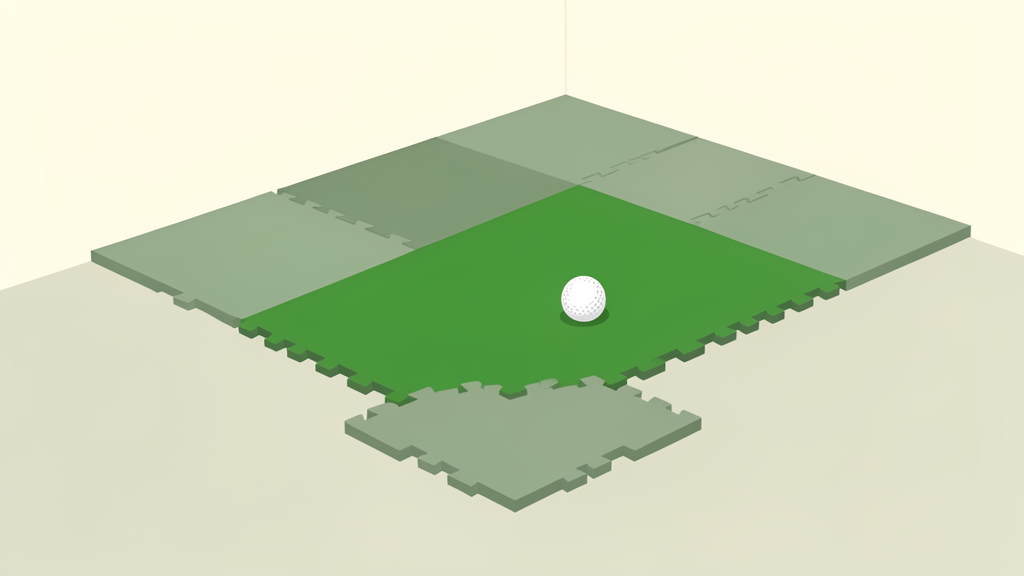
You spent $5,000 on a launch monitor. You spent $800 on an enclosure. You bolted a hitting mat to a frame and hung an impact screen. Then you stood on bare concrete in your garage and hit balls for 45 minutes and your knees sounded like bubble wrap.
That was me, two years ago. I built a home simulator setup and forgot about the floor entirely. Concrete is free, so I figured it was fine. It is not fine. Concrete destroys your joints over a 90-minute session. It makes every ball bounce like a Super Ball. And the sound of a golf ball hitting concrete at 90 mph will make your family question every decision you have ever made.
The flooring under your simulator is not an afterthought. It is the difference between a sim you use every day and one that gathers dust because your back hurts after 20 minutes. Every forum thread on r/Golfsimulator eventually gets to the same question: “What did you put under your turf?” The answers are all over the place because nobody has written a real comparison.
1. ProsourceFit 1-Inch Foam Tiles: $55
Best for: The 90% of sim builders who just need cushion under their turf without overthinking it.
ProsourceFit 1-inch EVA foam tiles are the single most-recommended flooring solution on r/Golfsimulator, and for good reason. You get 24 square feet of 1-inch thick interlocking foam for $55. Two boxes cover a 48-square-foot hitting bay for $110. That is less than the cost of a single Shop Indoor Golf sim tile.
The tiles are EVA foam with a puzzle-edge interlock. They go down in 10 minutes with no tools. You lay them directly on concrete, drop your turf on top, and you have a cushioned floor that absorbs the shock of walking, standing, and hitting for an hour without wrecking your knees. One Reddit user wrote: “I bought two boxes of 72 square feet for less than $100 each. 24x24, 1-inch thick ProsourceFit interlocking foam off Amazon.”
What does not work. The foam compresses over time in high-traffic areas. If you are hitting balls every day, expect to replace them every 2-3 years. The seams can show through thin turf. And if you drop a golf ball on exposed foam, it bounces everywhere.
Verdict: Buy it. This is the floor under my simulator right now. $110 for 48 square feet of cushion. It does the job.
2. IncStores 8mm Strong Rubber Tiles: ~$14 per tile
Best for: Garage setups where you need durability over cushion, or as a base layer under foam for a double-layer system.
IncStores 8mm Strong Rubber Tiles are recycled rubber interlocking tiles, 23 inches by 23 inches, sold individually at about $14 per tile. A 6-tile kit covers roughly 22 square feet for about $84. To cover a standard 8x6 hitting bay, you are looking at $250-$350 depending on how many tiles you buy.
Rubber does not compress like foam. It will not develop permanent dents from standing in the same spot. It deadens ball bounce better than any foam option. A ball dropped on rubber thuds and stops. A ball dropped on foam bounces two feet. That matters when you are chipping in the sim and your shanked wedge ricochets off the floor into your enclosure frame.
What does not work. Rubber is heavy. Each tile weighs about 10 pounds, so a full floor is 150-plus pounds of material to move if you ever rearrange. It is also harder than foam underfoot. If joint comfort is your priority, rubber alone is not enough. Stack foam on top of rubber for the best of both: durability below, cushion above.
Verdict: Worth it if you want a floor that lasts 10 years. Pair it with a thin foam layer on top and you have a permanent setup that will outlast your simulator.
3. Greatmats Royal Interlocking Carpet Tiles: ~$11 per tile
Best for: Sim builders who want a finished-room look without building a wood subfloor.
Greatmats Royal Interlocking Carpet Tiles are 2x2-foot tiles with a carpeted top bonded to a foam base. At about $11 per tile, covering 48 square feet costs around $130. They are waterproof, mold-resistant, and lay directly on concrete with no adhesive.
These tiles solve a problem foam and rubber do not: they look like a room, not a gym. If your simulator lives in a basement that also functions as a media room or guest space, carpet tiles give you a floor that does not scream “man cave.” The foam backing provides modest cushioning, less than dedicated 1-inch foam but enough to take the edge off concrete.
What does not work. The cushioning is thin. If you stand and hit balls for an hour, your feet will feel it. You will likely want a hitting mat with its own padding on top, which brings the total height up and creates a lip between your standing surface and hitting surface. That height difference is annoying and can affect your swing plane if it is more than an inch.
Verdict: Buy it for finished spaces, skip it for garages. If your sim is in a basement living area, these look great. If it is in a garage, stick with foam or rubber.
4. Shop Indoor Golf Simulator Gym Floor Tiles: $70+ per tile
Best for: The sim builder who wants a purpose-built, professional-grade floor and does not care about the price.
Shop Indoor Golf sells 24x24-inch tiles in four thicknesses: 1/2 inch, 5/8 inch, 3/4 inch, and 1 inch. Prices start at $70 per tile and scale up with thickness. A full 48-square-foot bay in 3/4-inch tiles runs $700-$900. These are not sold on Amazon. They are direct purchase from the manufacturer.
The pitch is that these tiles are designed specifically for golf simulator use. They are denser than gym foam, they hold their shape under repeated standing and swinging, and they cut cleanly so you can recess a hitting mat or strip for a flush, built-in look. Carl’s Place sells a similar system with 1.25-inch foam tiles that interlock and create a stable, cushioned base designed to be cut and fitted around your hitting mat.
What does not work. The price. You are paying 10x what the ProsourceFit foam costs for a product that solves the same core problem: cushioning your feet on concrete. The flush-fit recessed mat looks fantastic in photos, but most sim builders never bother with it. They drop a hitting mat on top of the floor and call it done.
Verdict: Skip it unless you are building a showcase sim. If you are spending $10,000 on a Full Swing or TrackMan setup, spend the $700 on matching tiles. If you are building a $1,500 garage sim, the foam does the same job for $110.
What I Would Actually Buy
For a garage simulator on a budget: ProsourceFit 1-inch foam tiles ($110 for two boxes) covering 48 square feet. Drop your hitting mat and practice net on top. Total flooring cost: $110. That is less than a single driver fitting.
If you want a floor that lasts a decade and deadens ball bounce: IncStores rubber tiles ($300) plus ProsourceFit foam ($55) on top. The rubber gives you a permanent, indestructible base. The foam gives you cushion. Total: $355. Still half what the Shop Indoor Golf tiles cost.
If your simulator is in a finished basement and you care about aesthetics: Greatmats Royal Carpet Tiles ($130) for the standing area, with a dedicated hitting mat on top. It looks like a room, not a gym.
Most sim builders overpay for branded “simulator flooring” when $55 foam tiles from Amazon do the same job. The flooring does not track your spin rate. It does not improve your launch angle. It keeps your knees from hurting. That is its entire job, and foam does it for $55.
Where to Buy
- ProsourceFit 1-Inch Foam Tiles $55 at Amazon
- IncStores 8mm Strong Rubber Tiles $14 per tile at Amazon
- Greatmats Royal Carpet Tiles $11 per tile at Amazon
- Shop Indoor Golf Gym Floor Tiles $70+ per tile at Amazon (direct purchase also available)
Prices verified July 2026. As an Amazon Associate we earn from qualifying purchases.