guides
Best Golf Net and Mat for Basement: $55-$695
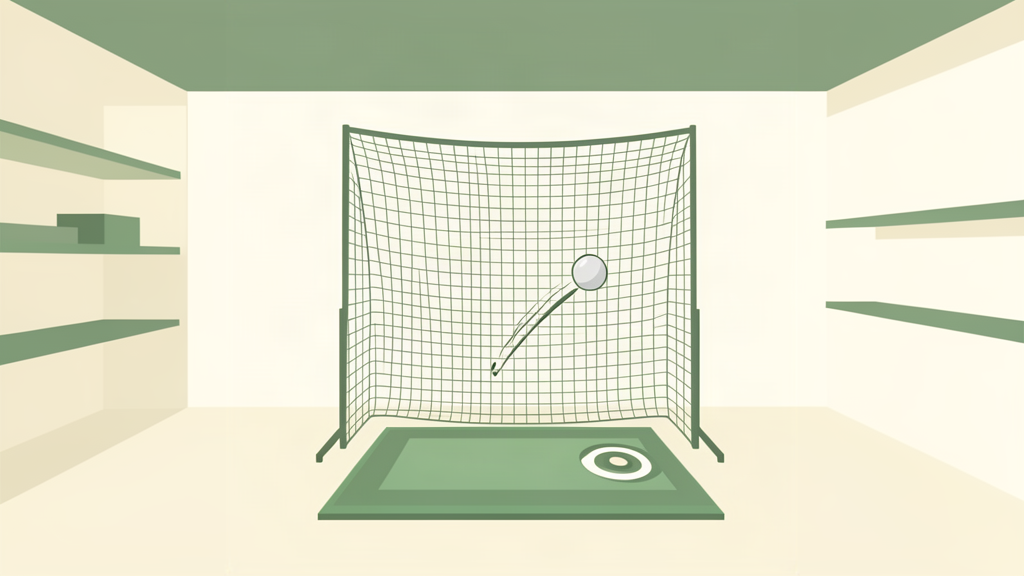
I spent my first winter in Chicago swinging a 3-wood in a basement with a 7-foot-4 ceiling. I measured that ceiling three times before I bought a single piece of gear. Then I took one full driver swing, caught the drywall with the clubhead, and spent forty minutes patching the hole with a spackle knife. I learned the hard way that in a basement, the net’s stated height is not the spec that matters. The ceiling is.
The Only Spec That Matters Is the Ceiling
Nearly every practice net on the market stands 7 feet tall, and basement ceilings run 7 to 9 feet. On paper those numbers match. They fall apart the second you take a real swing.
A full driver swing needs 8.5 to 9 feet of clearance above your feet. The net only has to be 7 feet tall because it sits a few feet in front of you and only has to catch the ball, not your backswing. Your clubhead, by contrast, travels a big arc that tops out well above your head. Put a 5-foot-10 golfer under a driver and the club reaches roughly 9 feet at the top.
Measure your ceiling, then subtract 6 to 8 inches for your own height and arm length. A 9-foot ceiling means you can hit driver. An 8-foot-6 ceiling means driver only if you shorten your swing. A 7-foot-8 basement means irons and wedges, nothing longer than a 5-iron at full speed.
That is not a reason to skip practice. It is a reason to buy the right net for the room you actually have. For the full range of net options, I covered the category in my best golf practice nets guide, the garage-specific pitfalls in my home golf practice area writeup, and the ceiling-height-tested net picks in my garage golf nets guide.
The Net Return Home Series V2 ($695): Fits the Room, Returns the Ball
Best for: a finished basement you plan to hit in for years.
The Home Series V2 is 7 feet tall, 7 feet wide, and 3 feet 6 inches deep, so it tucks into a corner a 10-foot-wide net will not. It carries the same 3-year or 250,000-shot warranty as Net Return’s $795 Pro Series and is rated for ball speeds up to 225 mph. The frame is aircraft aluminum and weighs 26 pounds.
The reason to pay up is one feature: it returns every ball to your feet. You swing, and the ball comes back to your toes. No walking, no bending, no chasing balls across a concrete floor. In a basement directly under the living room, that also cuts the noise by a third, because you are swinging a club instead of pacing around in golf shoes.
What does not work. At $695 it is four times the price of every other net in this guide. You are paying for ball return and durability, not for a taller net. If your ceiling is the problem, this does not add a single inch of clearance.
Verdict: Worth it if you want a net that still stands in five years and you refuse to chase a single ball.
Rukket Haack Golf Net Pro ($160 to $230): Buy It While It Is Still for Sale
Best for: the golfer who wants a wide, forgiving net on a budget, right now.
The Haack Pro is 9 feet wide and 7 feet tall, and those extra 2 feet of width are a real safety margin for mid-handicappers who shank one into the side pole. It sets up in 2 or 3 minutes with a push-button steel frame, and it has a floating target sheet plus a ball return that rolls the ball about 6 feet in front of you.
Rukket appears to have gone out of business in late 2026. The site is down, and users report that warranty replacements and parts are drying up. The net earned its reputation partly on Rukket replacing torn netting quickly. That support no longer exists.
What does not work. The carry bag is thin and rips, the first solo setup is awkward, and the ball return does not funnel mishits cleanly. Worst of all, you may not be able to get a replacement net if it wears through.
Verdict: Buy it only if you find it in stock and accept that parts and warranty are gone for good.
Rukket SPDR Net ($100 to $150): Heavier Frame, Same Risk
Best for: a portable net for occasional indoor use.
The SPDR is Rukket’s other net: 10 feet wide, 7 feet tall, and a 28-pound steel frame that sits 13 pounds heavier than the Haack. That extra mass keeps it stable on a hard basement floor. It uses the same dual-screen netting and handles a full driver.
What does not work. Everything I said about Rukket applies here too. The company is gone, so a torn net is a torn net. At $100 to $150, the SPDR makes sense only as a stopgap while you save for something with a warranty.
Verdict: Buy it only if you want a cheap net for a few months and are fine walking away from it.
GoSports Basic 10x7 Net ($130): The Budget Pick for Low Ceilings
Best for: a golfer who is not sure they will stick with basement practice.
This is GoSports’ budget net, 10 feet wide and 7 feet tall, with a fiberglass frame and a 4.4-star rating across thousands of reviews. It is the cheapest net I would recommend, and at 7 feet tall it clears the same low ceilings as the $695 net above.
What does not work. The netting is single-ply and the frame is fiberglass, not steel. This is not built for daily driver use. Treat it like a trial subscription to indoor practice: use it for a few weeks to see if the habit sticks, then upgrade if it does.
Verdict: Worth it if you are testing whether you will actually use a basement setup before spending real money.
Hitting Mats: Buy for the Floor, Not the Turf
Best for: protecting your joints on a concrete basement floor.
This is where most basement golfers get hurt, literally. A thin mat laid on bare concrete sends every fat shot straight into your wrists and elbows. The fix is not a $500 mat. It is a $55 layer of foam under a decent mat.
Start with a box of 1-inch ProsourceFit foam interlocking tiles ($54.99) under your hitting area. They absorb the shock that concrete will not, and they quiet the floor thud that carries upstairs. On top of that, the GoSports Elite 5-foot by 4-foot mat ($120 to $150) is the concrete-friendly pick because its non-slip backing grips a slab instead of sliding mid-swing. If you only chip and take half swings, the Rukket Tri-Turf mat ($59) is thinner and fine for light use.
I walked through the full mat list in my best golf mat for concrete deep dive, so I will not repeat it here. The short version: fix the floor before you buy a fancy mat.
Verdict: Buy the foam tiles first. They are the highest-value purchase in any concrete-floor setup.
What I Would Actually Buy
If money is not the issue, the Net Return Home Series V2 ($695) is the answer. It returns every ball, it lasts, and it carries a real warranty. That is the last net you will buy for a long time.
If $695 is too much, the honest budget build is the GoSports Basic 10x7 net ($130) plus a GoSports Elite mat ($130) plus a box of foam tiles ($55). That is $315 all in, and it is a legitimate place to hit balls indoors right now. It is also less than the cost of five dozen Pro V1s, which puts the whole project in perspective.
Whatever you spend, measure the ceiling first. The best net in the world is useless if your driver hits drywall on the way up.
Where to Buy
- The Net Return Home Series V2 $695 at Amazon
- GoSports Basic 10x7 Golf Net $130 at Amazon
- Rukket Haack Golf Net Pro $160 to $230 at Amazon
- GoSports Elite 5x4 Hitting Mat $120 to $150 at Amazon
- ProsourceFit 1-Inch Foam Tiles $54.99 at Amazon
As an Amazon Associate we earn from qualifying purchases.